
History of the National Cricket Academy
History of the NCA
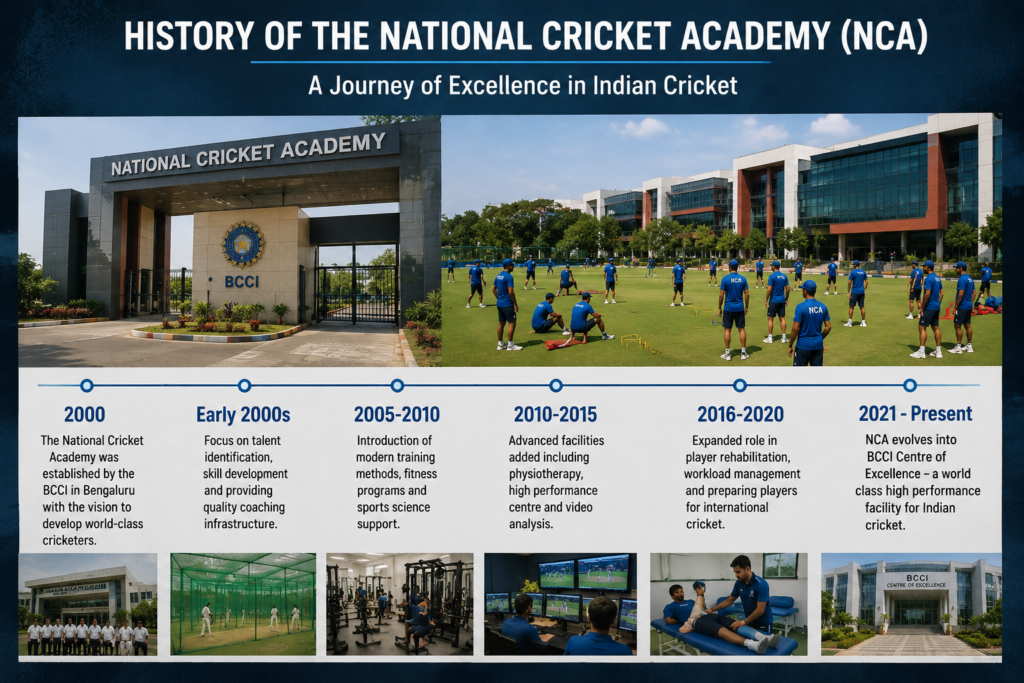
The National Cricket Academy has played an important role in the growth of Indian cricket by creating a structured environment for developing talented players. Before its establishment, promising cricketers largely depended on local coaches, schools, clubs, universities, and state associations for training. While many exceptional players emerged through these systems, there was no centralized high-performance centre where elite players could receive advanced coaching, scientific fitness support, and professional rehabilitation.
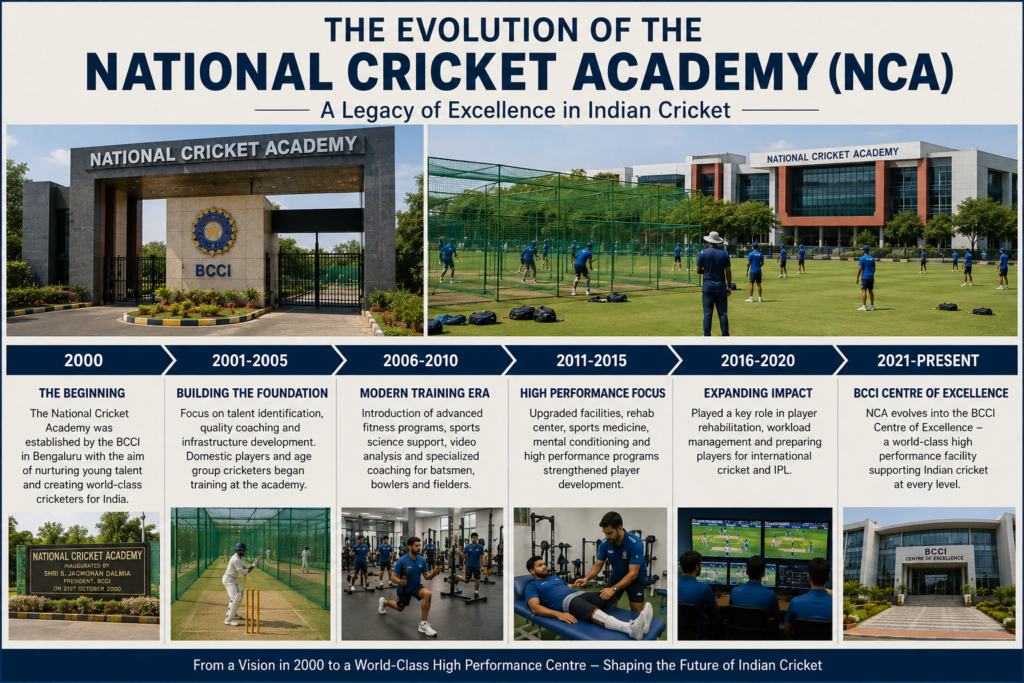
Recognizing this need, the Board of Control for Cricket in India (BCCI) established the National Cricket Academy in Bengaluru in the year 2000. The objective was to strengthen India’s cricket development system by providing selected players with access to world-class coaching and performance support.
From its early years, the academy focused on helping players improve their technical skills, physical conditioning, tactical understanding, and overall match preparation. Over time, it expanded its role to include sports science, biomechanics, nutrition, mental conditioning, workload management, injury rehabilitation, and coach education.
Today, the academy represents one of the most significant milestones in the professional development of Indian cricketers. It has contributed to improving coaching standards, fitness culture, and scientific training methods across Indian cricket.
Evolution into the BCCI Centre of Excellence
As cricket evolved into a faster and more physically demanding sport, player development required more than traditional coaching. Modern cricketers needed access to advanced medical facilities, performance analysis, rehabilitation specialists, and scientific training methods.
To meet these changing requirements, the BCCI expanded the National Cricket Academy into a larger high-performance ecosystem known as the BCCI Centre of Excellence.
The Centre of Excellence represents the next stage in Indian cricket’s commitment to player development. It combines coaching, sports science, medicine, fitness, nutrition, psychology, technology, and education under one integrated system.
The objective is to create an environment where talented cricketers can develop every aspect of their performance rather than focusing only on batting or bowling skills.
This evolution demonstrates how modern cricket increasingly relies on science, planning, and long-term athlete development.
Modern Training Philosophy
Professional cricket today demands excellence in multiple areas.
A technically gifted batsman also requires excellent fitness.
A fast bowler must understand workload management.
A wicketkeeper needs agility, reflexes, and endurance.
An all-rounder must balance multiple physical demands while maintaining consistent performance.
Modern coaching therefore focuses on developing complete athletes rather than simply improving individual cricket skills.
Training programs are designed around five major pillars.
Technical Development
Technical coaching remains the foundation of player development.
Players work on:
- Batting fundamentals
- Footwork
- Shot selection
- Bowling actions
- Swing bowling
- Seam bowling
- Spin variations
- Wicketkeeping techniques
- Fielding skills
- Throwing accuracy
Rather than encouraging shortcuts, coaches emphasize strong fundamentals that remain effective under different match conditions.
Tactical Awareness
Understanding the game is just as important as mastering techniques.
Players learn to:
- Read match situations.
- Build innings patiently.
- Rotate strike effectively.
- Set fields strategically.
- Understand opposition strengths.
- Plan bowling spells.
- Adapt to different pitch conditions.
- Make better decisions under pressure.
Game awareness develops through experience, observation, and continuous learning.
Physical Development
Modern cricket requires exceptional athletic ability.
Fitness programs typically focus on:
- Strength
- Power
- Speed
- Endurance
- Agility
- Balance
- Coordination
- Flexibility
- Mobility
- Recovery
Each player’s fitness requirements vary depending on their playing role.
Fast bowlers often require different conditioning programs than wicketkeepers or batsmen.
Mental Development
Cricket is often described as a mental game.
Players regularly face situations involving pressure, disappointment, expectations, and intense competition.
Mental conditioning helps athletes develop:
- Confidence
- Concentration
- Emotional control
- Patience
- Resilience
- Positive thinking
- Self-belief
- Decision-making
Developing mental strength enables players to perform consistently regardless of match circumstances.
Character Development
Professional cricket also requires strong personal values.
Players are encouraged to develop:
- Discipline
- Responsibility
- Respect
- Teamwork
- Leadership
- Humility
- Integrity
- Commitment
These qualities contribute not only to cricket success but also to personal growth beyond the playing field.
High-Performance Training Facilities
Modern cricket training relies on specialised facilities designed to improve every aspect of performance.
Although facilities continue to evolve, high-performance cricket environments generally include resources such as:
Practice Nets
Dedicated practice areas allow players to work on batting and bowling techniques under different conditions.
Specialized nets may simulate various match situations to improve adaptability.
Match Simulation Areas
Match simulation helps players practice decision-making under realistic game scenarios.
These sessions improve tactical awareness and pressure handling.
Strength and Conditioning Centre
A professional gym supports:
- Strength development
- Core stability
- Functional movement
- Injury prevention
- Athletic performance
Fitness specialists design individualized training plans according to player requirements.
Sports Science Laboratory
Scientific testing provides valuable information about:
- Athletic performance
- Movement efficiency
- Fitness levels
- Recovery needs
- Injury prevention
Objective data helps coaches make informed training decisions.
Video Analysis
Technology allows coaches to review:
- Batting techniques
- Bowling actions
- Field placements
- Running between wickets
- Match performances
Players can better understand their strengths and identify areas requiring improvement.
Rehabilitation Centre
Injuries are an unavoidable part of professional sport.
Structured rehabilitation programs help athletes recover safely while gradually rebuilding strength, mobility, confidence, and match readiness.
Importance of Sports Science
Sports science has transformed modern cricket.
Training is no longer based only on observation.
Scientific measurements help improve:
- Running speed
- Bowling workload
- Jump performance
- Flexibility
- Strength
- Recovery
- Nutrition planning
By monitoring these factors, coaches can reduce injury risks while maximizing athletic performance.
Sports science supports smarter training rather than simply increasing training volume.
The Role of Technology in Cricket Development
Technology has become an essential component of player development.
Modern tools allow coaches and analysts to examine every aspect of performance with greater accuracy.
Examples include:
- High-speed video analysis
- Ball tracking technology
- Motion analysis
- Performance databases
- GPS workload monitoring
- Fitness testing software
These tools provide objective feedback that complements traditional coaching experience.
Technology does not replace coaches—it enhances their ability to help players improve.
Learning Beyond the Cricket Field
One of the most valuable lessons from high-performance cricket is that successful athletes continue learning throughout their careers.
Modern player development encourages athletes to:
- Study the game.
- Learn from experienced players.
- Understand fitness principles.
- Develop healthy lifestyles.
- Improve communication.
- Build leadership skills.
- Maintain professionalism.
- Balance education and sport.
Continuous learning creates more adaptable and resilient athletes capable of performing consistently over long careers.
What Aspiring Cricketers Can Learn
Although not every player will train at a high-performance centre, every aspiring cricketer can apply the same principles.
Focus on:
- Building strong fundamentals.
- Training consistently.
- Improving physical fitness.
- Developing mental resilience.
- Learning from experienced coaches.
- Competing regularly.
- Maintaining discipline.
- Embracing continuous improvement.
Success in cricket is rarely the result of a single opportunity. It is usually built through years of dedicated practice, patience, and consistent performances. The philosophy behind high-performance cricket reminds every aspiring player that excellence is achieved through preparation, commitment, and a willingness to keep learning every day.